
When it comes to sewer line replacement, homeowners often face a daunting reality. A damaged sewer line can disrupt daily life and lead to messy situations. If you have noticed issues like persistent slow drainage, gurgling sounds in your pipes, or foul sewage odors, it might be time to consider a replacement.
Quick Summary for Sewer Line Replacement:
Warning Signs:
– Persistent slow drainage
– Gurgling sounds in pipes
– Foul sewage odors
Causes of Damage:
– Tree roots
– Temperature extremes
– Corrosion in old pipes
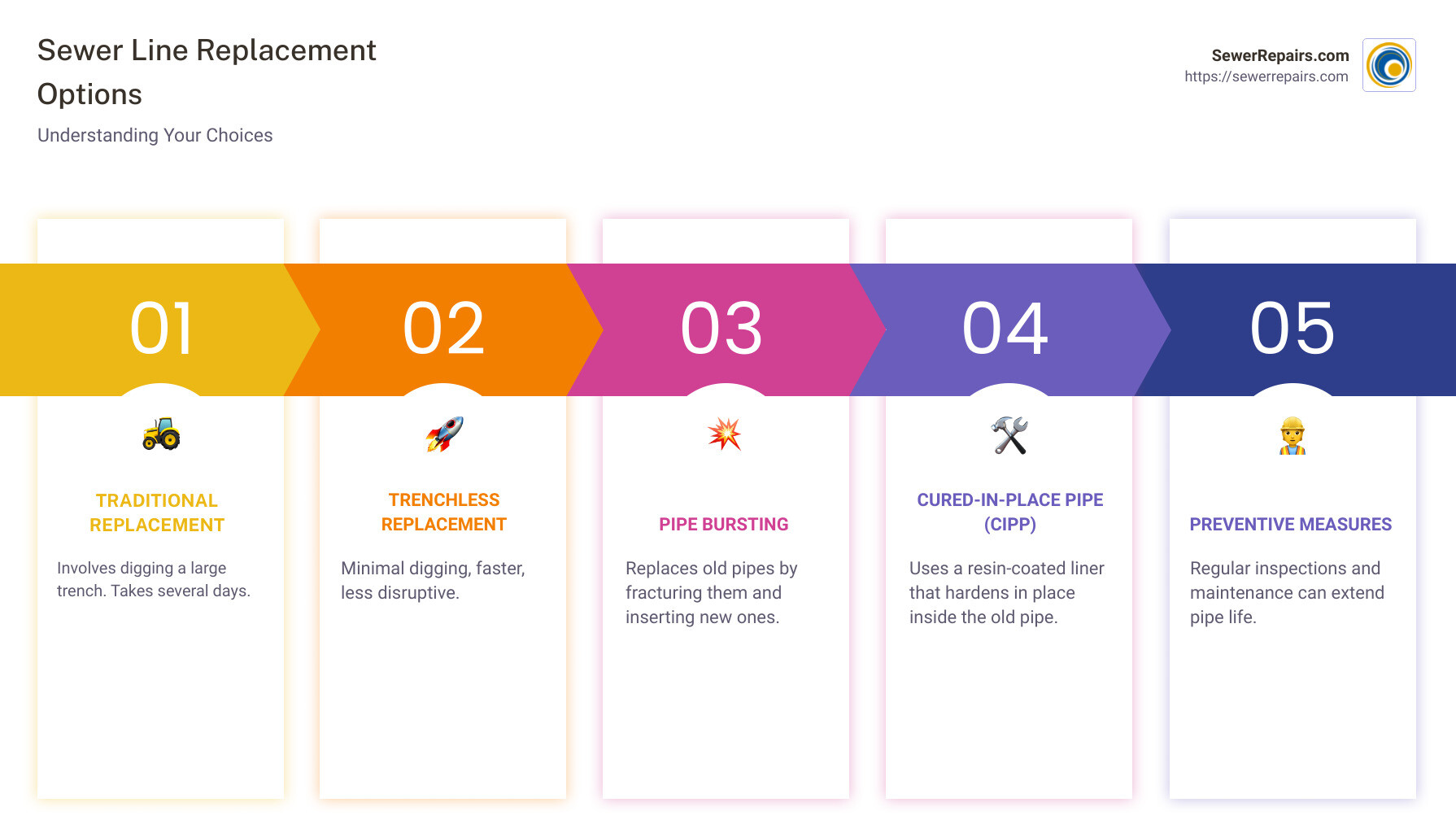
Replacement Options:
– Traditional Replacement: Involves digging a large trench, takes several days.
– Trenchless Replacement: Minimal digging, faster, less disruptive.
Thinking about replacing your sewer line is important because ignoring the issue can lead to major property damage and costly repairs. It is vital to identify the early signs and know your options.
Recognizing the Need for Sewer Line Replacement
Knowing when your sewer line needs replacing can save you from a lot of headaches and costly repairs. Here are some key warning signs to look out for:
Warning Signs
Spike in Water Bill
If you’ve noticed an unexpected increase in your water bill, it could be a sign of a hidden leak in your sewer line. Leaks waste water and can cause your bill to skyrocket.
Gurgling Pipes
Hearing gurgling sounds when you flush the toilet or run water in the sink? This might mean there’s a blockage or improper flow in your sewer line. The noise happens because air is trapped in the pipes due to restricted flow.
Slow Drainage
Persistent slow drainage in sinks, tubs, and toilets can indicate a major problem. It might mean that there’s a buildup or blockage in the sewer line that needs attention.
Soggy Yard
Is there a wet, soggy patch in your yard that never seems to dry out? This could be a sign of a sewer line leak. Wastewater can saturate the ground, causing it to become unusually wet.
Sewage Smell
A foul sewage odor in your home or yard is a telltale sign of a sewer line issue. Cracks or leaks in the sewer line can allow sewage gases to escape, creating an unpleasant smell.
Pest Attraction
Rats and insects are often attracted to the scent of sewage. If you notice an increase in pests around your home, it might be due to a sewer line break. These pests can even enter your home through the damaged line.
Toilet Water Level Fluctuations
If the water level in your toilet bowl rises and falls without reason, it could point to a problem in the sewer line. This fluctuation happens when there is a blockage or leak affecting the flow of water.
Recognizing these signs early can help you avoid more severe damage and costly repairs. If you notice any of these issues, call a professional to inspect your sewer line and determine the best course of action.

Next, we’ll dive into how long sewer line replacement takes and the factors that can influence the duration of the project.
How Long Does Sewer Line Replacement Take?
When it comes to sewer line replacement, the duration can vary widely. Several factors influence how long the project will take, from the type of replacement method used to the specific layout of your property.
Factors Influencing Replacement Time
1. Project Duration
The time required for a sewer line replacement can range from a single day to several weeks. For instance, a simple project on a small property might be completed in a day, while more complex jobs can take much longer.
2. Property Layout
The layout of your property is a significant factor. If the sewer line runs under a driveway or other hardscaping, it will take longer to excavate and replace. Conversely, if the line is easily accessible, the work can be completed more quickly.
3. Piping System
The existing piping system also plays a role. Older pipes made of materials like cast iron or clay require more careful handling and can take longer to replace than newer PVC pipes.
4. Excavation Depth
The depth of the sewer line affects the time needed for replacement. Lines that are buried deeper underground take longer to excavate and replace. In colder regions, sewer lines are usually deeper to prevent freezing, which can add time to the project.
5. Traditional vs. Trenchless
The method used for replacement is crucial. Traditional excavation involves digging up the existing line and can be very time-consuming. On the other hand, trenchless methods like pipe bursting and Cured-in-Place Pipe (CIPP) lining are faster and less disruptive. Trenchless methods can often be completed in a day or two, whereas traditional methods may take up to a week or more.
6. Depth and Length
The length and depth of the sewer line also impact the duration. Longer lines require more time to replace, and deeper lines are more challenging to access.
7. Accessibility
Accessibility is another key factor. If the sewer line is in a hard-to-reach area, it will take longer to replace. For example, lines running under buildings or large trees require more complex excavation work.
8. Urban vs. Suburban Settings
Urban settings can complicate sewer line replacement due to factors like traffic, underground utilities, and limited space for excavation. In contrast, suburban settings often allow for easier access and fewer obstacles, potentially speeding up the process.
Summary
Understanding these factors can help you better estimate the time required for your sewer line replacement. Being aware of the potential duration allows you to plan accordingly and minimize disruptions to your daily life.
Methods of Sewer Line Replacement
When it comes to sewer line replacement, there are several methods available, each with its own pros and cons. Understanding these methods will help you make an informed decision that suits your needs and budget.
Traditional Replacement
Traditional sewer line replacement involves digging a large trench to access and replace the entire length of the damaged pipe. This method is thorough and allows for a complete inspection and replacement of the sewer line.
Pros:
– Thorough inspection: Every part of the pipe is accessible, allowing for a comprehensive replacement.
– Long-lasting results: New pipes can last for decades if properly installed.
Cons:
– Disruptive: Requires significant excavation, which can damage lawns, driveways, and other landscaping.
– Time-consuming: Can take several days to complete, especially if there are obstacles like sidewalks or trees.
Trenchless Technology
Trenchless sewer line replacement is a less invasive method that requires minimal digging. Two common techniques are pipe bursting and cured-in-place pipe (CIPP).
Pipe Bursting
In pipe bursting, a cone-shaped bursting head is sent through the existing pipe. As it moves, it breaks the old pipe apart and pulls a new pipe into place behind it.
Pros:
– Minimal disruption: Only small access points are needed, preserving your lawn and landscaping.
– Time-efficient: Often completed in a single day.
Cons:
– Slightly more expensive: Generally costs more upfront than traditional methods.
– Not suitable for all conditions: May not work if the existing pipe is severely collapsed.
Cured-in-Place Pipe (CIPP)
CIPP involves inserting a flexible liner coated with resin into the damaged pipe. The liner is then inflated and cured, forming a new pipe within the old one.
Pros:
– No excavation needed: Completely trenchless, causing minimal disruption.
– Quick process: Can be completed quickly, often within a day.
Cons:
– Limited to certain types of damage: Best for pipes that are still structurally sound but have minor cracks or leaks.
– Longevity: While effective, the new lining may not last as long as a completely new pipe.
Comparing Replacement Techniques
When choosing a sewer line replacement method, consider the following factors:
Cost-effectiveness:
– Traditional methods may be cheaper initially but can incur additional costs for landscape restoration.
– Trenchless methods have higher upfront costs but save money on restoration and are often quicker.
Time efficiency:
– Traditional replacement can take several days due to extensive excavation.
– Trenchless methods like pipe bursting and CIPP can often be completed in a single day.
Property impact:
– Traditional methods can significantly disrupt your property, requiring extensive restoration.
– Trenchless methods cause minimal disruption, preserving your lawn and landscaping.
Forbes Insights:
According to Forbes, trenchless methods are becoming increasingly popular due to their efficiency and minimal impact on properties. They note that while trenchless methods can be more expensive upfront, the long-term savings and reduced hassle often make them a better choice for many homeowners.
Understanding these methods and their implications can help you make the best decision for your sewer line replacement. Next, we’ll dive into the costs and financial considerations associated with these methods.
Costs and Financial Considerations in Sewer Line Replacement
Planning Your Budget
Average Costs:
Sewer line replacement can be a significant investment. On average, homeowners spend around $4,000 on this project. However, costs can range widely, from as low as $650 for minor repairs to as high as $25,000 for extensive replacements.
Per Foot Pricing:
Expect to pay between $55 and $250 per linear foot for sewer line replacement. This range depends on factors like the depth of the pipe, the type of soil, and the method used.
| Length (Feet) | Low Cost | High Cost |
|---|---|---|
| 5 | $275 | $1,250 |
| 10 | $550 | $2,500 |
| 20 | $1,100 | $5,000 |
Material Costs:
The type of material used for your new sewer line also affects the cost. Here’s a quick breakdown:
- ABS Plastic: $140 to $260 per 50 linear feet
- PVC Plastic: $80 to $400 per 50 linear feet
- Cast Iron: $1,200 to $3,700 per 50 linear feet
Additional Expenses:
Beyond the basic replacement costs, you might encounter other expenses:
- Excavation and Restoration: If digging is required, you’ll need to budget for restoring your yard or driveway afterward.
- Permits: Local regulations often require permits for sewer work. A reputable contractor will help you navigate this process.
- Cleaning: If there’s a backup or spill, you may need professional cleaning services, adding to the total cost.
Insurance Coverage:
Most standard homeowners insurance policies do not cover sewer line replacements unless the damage is caused by a third party. However, it is worth checking with your insurance provider to understand your coverage. Some policies might cover damage caused by specific events like natural disasters.
Home Warranty:
If you are concerned about potential future costs, consider a home warranty that includes septic system coverage. While this can be an added expense, it provides peace of mind and financial protection against unexpected repairs.
Estimates:
Always get multiple quotes before deciding on a contractor. Aim to collect at least three estimates to compare costs and services. This helps ensure you’re getting a fair price.
Unexpected Costs:
Be prepared for surprises. Unanticipated issues, such as discovering additional damage or complications during the replacement, can add to the cost. It’s wise to set aside a contingency fund—around 10-20% of the project’s estimated cost.
Saving Tips:
– Trenchless Methods: While they have a higher upfront cost, trenchless methods often save money in the long run by reducing restoration costs.
– Off-Peak Scheduling: Contractors might offer discounts during their off-peak seasons.
– DIY Prep Work: If possible, handle some of the prep work yourself, like clearing access to the sewer line, to reduce labor costs.
Understanding these financial aspects will help you plan and budget effectively for your sewer line replacement. Next, we’ll address some frequently asked questions to further clarify this complex process.
Frequently Asked Questions about Sewer Line Replacement
How do you know if a sewer line needs to be replaced?
Knowing when to replace your sewer line is crucial. Here are some warning signs that indicate it might be time for a replacement:
- Persistent Drain Backups: If your drains keep backing up despite frequent cleaning, it could be a sign of a bigger problem.
- Slow Drainage: Consistently slow drains can indicate a blockage or deteriorating pipe.
- Gurgling Sounds: Strange noises coming from your drains or toilets might mean there is an issue with your sewer line.
- Foul Odors: If you smell sewage in your home or yard, it’s a clear sign something is wrong.
- Soggy Yard: Pools of water or unusually lush patches in your yard can signal a leaking sewer line.
- Foundation Issues: Cracks in your home’s foundation could be caused by leaking sewer lines.
Before deciding on a replacement, it is essential to get a sewer line inspection. Professionals can use a digital camera to inspect the line and determine if a repair or full replacement is necessary.
How many years does a sewer line last?
The lifespan of a sewer line depends on the material used:
- PVC Pipes: Over 100 years
- Cast Iron Pipes: 75–100 years
- Clay and Cement Pipes: Up to 100 years
- Orangeburg Pipes: Around 50 years
External factors like tree roots, soil conditions, and extreme temperatures can shorten these lifespans. Regular maintenance and inspections can help extend the life of your sewer line.
What is the difference between a main line and a sewer line?
The main line and sewer line are often used interchangeably, but they refer to different parts of your home’s plumbing system:
- Main Line: This is the primary pipe that carries all the wastewater from your home to the municipal sewer system. It connects your home’s plumbing to the city’s sewer line.
- Sewer Line: This term generally refers to the entire system of pipes that transport wastewater from your home, including the main line.
Understanding these differences can help you better communicate with professionals and understand the scope of any needed repairs or replacements.
Next, we’ll dive into the costs and financial considerations associated with sewer line replacement. Stay tuned to learn how to budget for this essential home maintenance task.
Conclusion
Preventive Measures
Taking preventive measures can save you from costly and disruptive sewer line replacements. Here are some tips:
- Regular Inspections: Schedule yearly inspections to catch potential problems early. Professionals can use digital cameras to inspect your sewer line and identify issues before they become severe.
- Proper Disposal: Avoid flushing non-degradable items like baby wipes, sanitary products, and grease down your drains. These can cause blockages and damage your pipes.
- Tree Root Management: If you have trees near your sewer line, consider root barriers or regular root maintenance to prevent roots from invading your pipes.
Importance of Timely Replacement
Timely sewer line replacement is crucial for several reasons:
- Prevent Property Damage: Ignoring sewer line issues can lead to severe damage, including foundation problems, flooding, and contamination.
- Health and Safety: A malfunctioning sewer line can expose your family to harmful bacteria and unpleasant odors.
- Cost Savings: Addressing problems early can save you from more expensive repairs down the line. Trenchless methods, for example, can be more cost-effective and less disruptive than traditional methods.
Contact SewerRepairs.com for Expert Service
If you suspect issues with your sewer line, don’t wait. Contact us at SewerRepairs.com for a free, no-obligation on-site assessment. Our team of experts is committed to providing top-notch service, using the latest techniques to ensure minimal disruption and maximum efficiency.
We take pride in our work and have built a strong reputation for reliability and expertise. Let us help you keep your sewer system in top shape.
By following preventive measures and opting for timely replacements, you can protect your home and save money. For all your sewer line needs, SewerRepairs.com is here to help.