
When you’re facing sewer line issues, one of the biggest decisions you’ll need to make is whether to repair the existing line or replace it entirely. It’s not just a matter of fixing the immediate problem — it’s about choosing the most cost-effective, long-term solution for your property. Factors like the age of the pipes, the extent of the damage, soil conditions, and even local regulations all play a role. Understanding the pros and cons of each option can help you make an informed choice and avoid costly surprises down the road.
Quick Answer: Repair vs. Replacement Decision Guide
| Choose Repair When: | Choose Replacement When: |
|---|---|
| • Damage is limited to one small area | • Multiple sections are damaged |
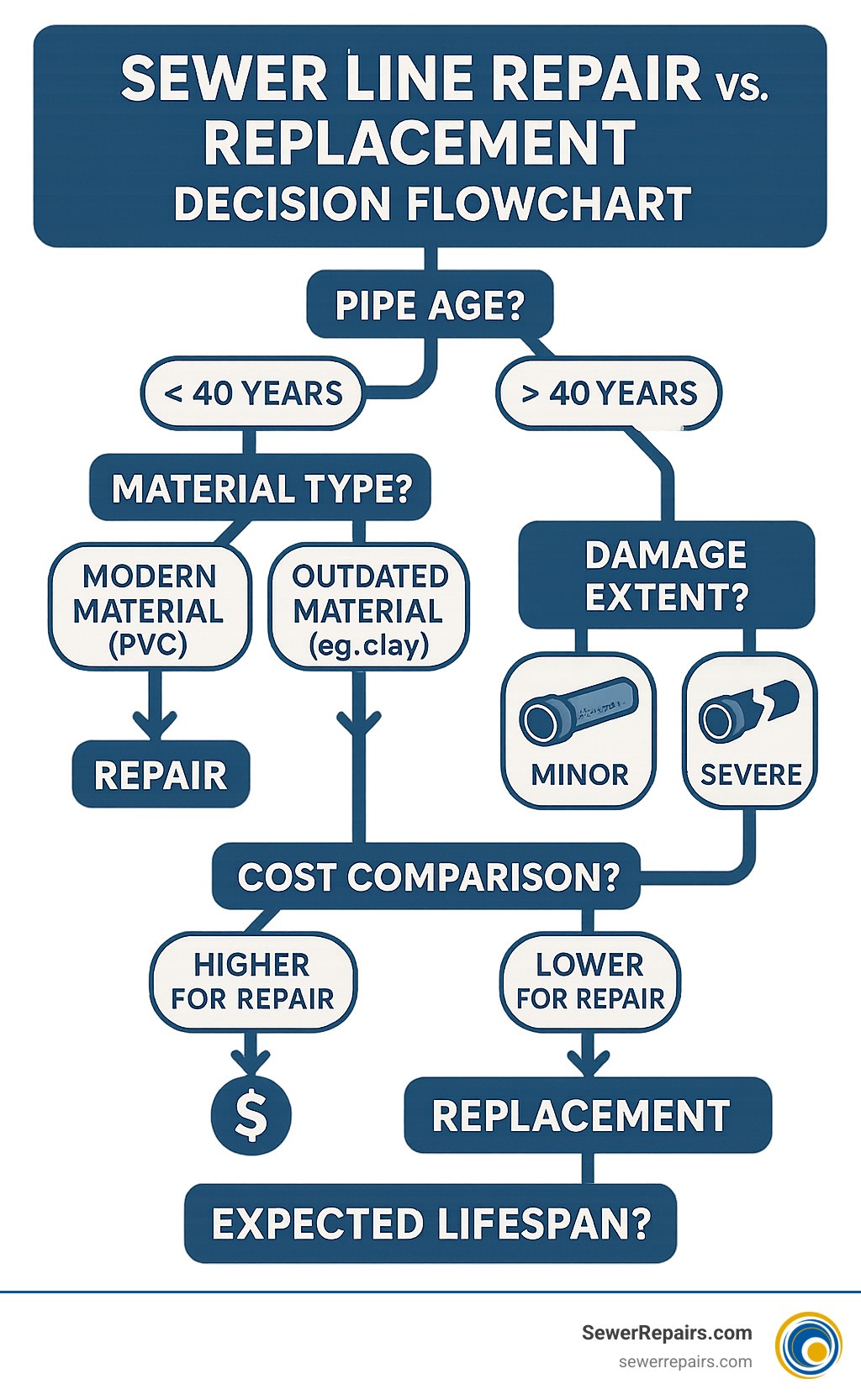
| • Pipe is less than 40 years old | • Pipe is over 40 years old |
| • Material is still in good condition | • Using outdated materials (Orangeburg, clay) |
| • Budget is limited right now | • Want long-term solution (50-100 years) |
| • No recurring backups or issues | • Experiencing frequent backups |
A malfunctioning sewer line is more than just a nuisance — it can quickly escalate into a serious and costly problem. From raw sewage backups and potential health hazards to structural damage that threatens your foundation, the risks are significant. Deciding whether to repair or replace a failing sewer line involves careful consideration of several key factors: the age and material of your pipes, the extent of the damage, your available budget, and how long you intend to remain in your home. A thoughtful evaluation now can help prevent major issues — and expenses — later.
Here’s something that surprises many homeowners: full replacement isn’t always necessary. For those small, isolated problems—think of them as pipe pimples—targeted repairs often do the trick without emptying your wallet. However, if your pipes are collecting social security or the damage looks like a pipe version of a five-car pileup, replacement might save you from future headaches and emergency plumber visits.
My name is Jason Best, and I’ve spent over two decades elbow-deep in sewer repair technologies as the founder of SewerRepairs.com. I’ve helped thousands of homeowners steer the confusing crossroads of repair versus replacement, always searching for solutions that won’t require a second mortgage or turning your yard into an archaeological dig site.
Why This Guide Matters
Sewer issues are like icebergs—what you can see is often just a hint of what’s lurking below. The scope of work needed can range from a quick patch job to a complete underground overhaul. Without proper guidance, you might find yourself staring at a bill with more zeros than you expected, wondering if your plumber is secretly funding a yacht.
The good news? Modern trenchless technologies have revolutionized the industry. The process is now potentially less invasive and more affordable—though admittedly more complex to understand. That’s where we come in. At SewerRepairs.com, we’re committed to reducing your stress levels by providing straightforward, expert guidance based on our extensive experience serving homeowners throughout Riverside, Corona, Redlands, and all of Southern California.
Think of this guide as your sewer line GPS—helping you steer around costly detours and steering you toward the most efficient route to a properly functioning plumbing system. No jargon, no scare tactics—just clear direction when you need it most.
Signs Your Sewer Line Needs Repair or Replacement
Before diving into the repair versus replacement decision, it’s crucial to recognize when your sewer line is in trouble. Early detection can save you significant money and prevent catastrophic failures.
Frequent Backups, Slow Drains & Odors
When your toilet gurgles every time you run the washing machine, your sewer line is trying to tell you something. One of the most telltale indicators of sewer troubles is when multiple plumbing fixtures back up simultaneously. This isn’t just an isolated clog – it’s your main sewer line crying for help.
If you notice multiple slow-draining fixtures throughout your home, pay attention. When your shower, toilet, and kitchen sink all seem sluggish, the problem likely lurks deep in your main line, not just in individual drains.
Those gurgling sounds from toilets when you’re using water elsewhere aren’t just quirky plumbing personalities – they’re distress signals. Similarly, foul odors wafting from drains or yard areas often indicate sewage escaping from where it should be contained. And if you’re experiencing sewage backups in lowest-level fixtures like basement toilets, you’ve got a serious situation that needs immediate attention.
Yard Changes & Foundation Red Flags
Your yard is often the first to reveal what’s happening underground. Think of it as your sewer line’s mood ring.
Have you noticed unusually lush, green patches of grass directly above your sewer line? While it might look nice, that extra “fertilization” is actually sewage feeding your lawn – definitely not something you want seeping into your soil.
I’ll never forget a Temecula homeowner who called us puzzled about “extremely green and soggy spots” in their otherwise drought-stressed yard. Our inspection revealed a significant crack in their clay pipe that had been quietly leaking for months.
Soggy spots or standing water in your yard when it hasn’t rained is another clear warning sign. More concerning are indentations or sinkholes forming in your lawn or driveway, which suggest soil being washed away by underground leaks.
When sewer line problems progress, they can even affect your home’s structure. Foundation cracks or settling and sinking of concrete slabs near the sewer line path indicate that water from leaking pipes may be undermining your home’s very foundation.
Pest Problems & Indoor Mold Growth
The problems don’t stop at water damage. A compromised sewer line creates a welcome mat for unwanted guests.
Increased rodent activity might be more than just neighborhood rats – they can actually enter your home through broken sewer pipes. Similarly, insect infestations, particularly sewer flies and cockroaches, find sewer leaks to be perfect breeding grounds.
Inside your home, watch for mold growth on walls, floors, or ceilings, especially in basements or lower levels. Those persistent musty odors might not be just old house smell – they could indicate sewage moisture creating unhealthy conditions.
Most concerning are unexplained respiratory issues among family members, which often occur when sewage gases and mold spores contaminate your indoor air. These aren’t just nuisances; they’re potential health hazards that deserve immediate attention.
When multiple warning signs appear, it’s time to consult professionals about whether your sewer line needs repair or complete replacement. At SewerRepairs.com, we’ve seen how early detection can transform a potential disaster into a manageable maintenance issue.
What’s Damaging Your Sewer Line? Causes & Pipe Material Impact
Understanding what’s causing your sewer line damage helps determine whether repair or replacement is the better solution.
Age & Original Material Matter
The lifespan of your sewer line depends heavily on the material it’s made from:
- Cast iron pipes: 75–100 years
- Clay pipes: Up to 100 years
- Orangeburg pipes (tar paper): Around 50 years
- PVC/ABS pipes: Over 100 years
- Concrete pipes: 70–100 years
- Asbestos-cement pipes: 40–60 years
“If you have more than one break in the pipe, you should consider replacing the entire sewer line to avoid additional issues in the future,” explains our lead technician at SewerRepairs.com. This is especially true for older materials like Orangeburg or clay.
Homes built between the 1940s and 1970s with Orangeburg pipes often require full replacement as these materials deteriorate more rapidly than modern alternatives. Similarly, clay pipes, while durable, are susceptible to root intrusion and cracking.
For more on how pipe materials affect longevity, visit our detailed guide on The Lifespan of Sewer Lines: Factors That Influence Longevity.
External Forces: Roots, Soil, Temperature
External factors commonly causing sewer line damage include:
- Tree root intrusion: Roots naturally seek moisture and can infiltrate tiny cracks in pipes, expanding them over time
- Soil shifting: Ground movement from earthquakes, construction, or natural settling
- Freeze-thaw cycles: Expansion and contraction of soil during temperature changes
- Heavy traffic: Vehicles driving over shallow sewer lines
- Construction damage: Accidental impacts during excavation or repaving projects
A homeowner in Corona called us after a sidewalk repaving project damaged their sewer line – a common occurrence when contractors aren’t aware of underground utilities.
Internal Culprits: Grease, Debris, Chemical Corrosion
What goes down your drains matters too:
- Grease buildup: Kitchen fats that solidify in pipes
- Non-flushable items: Wipes, paper towels, feminine hygiene products
- Chemical damage: Harsh drain cleaners that corrode pipes
- Scale accumulation: Mineral deposits that narrow pipe diameter
- Collapsing pipes: Internal structural failure due to age or pressure
Deciding Between Sewer Line Repair and Replacement
Now for the big decision: repair or replace? This choice hinges on several critical factors.
Key Decision Factors: Age, Damage Extent, Budget, Longevity
When our team at SewerRepairs.com sits down with homeowners in Riverside and surrounding areas, we often see the same worried expression. “Can we just fix this one spot, or do we need to bite the bullet and replace everything?” It’s a question that keeps many up at night.
The truth is, this decision isn’t one-size-fits-all. We carefully evaluate your unique situation considering several crucial elements. Pipe age speaks volumes – systems over 40 years old often warrant replacement even when damage seems contained. After all, if one section has failed, others may soon follow.
Damage patterns tell an important story too. As one of our customers in Corona recently finded, what looked like a single crack on camera actually revealed a pattern of deterioration throughout their aging clay pipe system.
The original pipe material can be the deciding factor all on its own. I’ll never forget the homeowner who insisted we try repairing their Orangeburg pipe to save money – only to have us back three months later for the full replacement we initially recommended.
Your financial situation matters tremendously. We understand budget constraints are real, which is why we present both immediate costs and long-term financial implications of each option. Sometimes what seems expensive today prevents multiple costly repairs down the road.
And don’t overlook your property plans. Are you settling in for decades or preparing to sell? For homeowners planning to stay put, the investment in replacement often pays dividends in peace of mind and avoided future headaches.
When Deciding Between Sewer Line Repair and Replacement, Cost Analysis Matters
Let’s talk dollars and cents – often the deciding factor when deciding between sewer line repair and replacement.
The financial landscape varies widely depending on your specific situation. Spot repairs typically run $60–$250 per foot, making them appealing for truly isolated issues. For comparison, trenchless repair methods generally cost about half of traditional excavation replacement, while preserving your landscaping and hardscaping.
A full replacement carries a national average of $5,000, though costs typically range from $3,000 to $25,000 depending on length, accessibility, and method chosen. Most residential projects fall somewhere in the middle, with shorter lines (25’–35′) costing $1,250–$8,750 and longer runs (100’–125′) ranging from $5,000–$31,250.
What many homeowners don’t initially consider is the compounding effect of multiple repairs. As one of our Redlands clients finded, three “affordable” repairs over five years ultimately cost more than the full replacement we originally suggested. According to Forbes cost insights, repair costs increase annually, making multiple fixes increasingly expensive.
Using Camera Inspection & Hydrostatic Testing to Guide the Choice
At SewerRepairs.com, we never recommend solutions based on guesswork. Modern technology allows us to make data-driven decisions that save you money and headaches.
Our high-definition video camera inspection is like giving your pipes a thorough medical exam. We can see exactly what’s happening inside, identifying not just obvious breaks but early warning signs of future problems. One Temecula homeowner was amazed when we showed him the root intrusion that had been slowly strangling his sewer line for years.
For suspected leaks that aren’t visually obvious, we employ hydrostatic pressure testing. This process, which involves sealing sections of pipe and pressurizing them with water, reveals even tiny leaks that cameras might miss. It’s particularly valuable when deciding between repair and replacement, as it reveals the true extent of the system’s integrity.
We also map your entire system during inspection, creating a detailed schematic showing pipe locations, depths, and problem areas. This mapping proves invaluable for planning the most efficient approach.
As I often explain to customers, “Think of this process as similar to having a stent put in during an operation. We need to see exactly what’s happening before we can recommend the right solution.” This thorough assessment ensures you’re making an informed decision based on your specific situation, not just general guidelines.
Comparing Methods: Spot Repair, Pipe Lining, Pipe Bursting & Full Replacement
When facing sewer line issues, understanding your repair options is like choosing the right tool for a job – each method has its perfect application. Let me walk you through the approaches we use daily at SewerRepairs.com to solve our customers’ problems.
Spot Repair & Sewer Repair Sleeve
Think of spot repairs as the “band-aid” approach – perfect when the problem is contained to a single area.
Just last month, a homeowner in Corona called us about a single crack in their otherwise healthy PVC line. Rather than suggesting a full replacement, we used a sewer repair sleeve – a much more affordable solution that took just hours instead of days.
Spot repairs work beautifully for isolated issues like small cracks or minor root intrusions. We typically dig only at the specific damage point, fix that section, and you’re good to go. The immediate cost is lower and there’s minimal disruption to your property. The main drawback? If your pipe has underlying issues elsewhere, you might need another repair down the road.
Curious about how these sleeves work? Check out our detailed guide on Sewer Repair Sleeve techniques.
Pipe Lining (CIPP)
Pipe lining is like giving your old pipes a new inner skin – it’s pretty remarkable technology. One of our Riverside customers described it as “magic” when we restored her 60-year-old pipes without digging up her prize-winning garden.
With Cured-In-Place Pipe (CIPP) lining, we create a brand new pipe inside your existing one. First, we thoroughly clean your pipe with high-pressure water jetting. Then, we insert a flexible tube coated with special resin. Using either hot water or UV light, we cure the resin until it hardens into a smooth, jointless new pipe.
The beauty of pipe lining is that there’s virtually no digging required except at access points. The new liner extends your pipe’s life by 20-50 years and can be completed in just 1-2 days in most cases. The only real downsides are a slight reduction in pipe diameter (usually not noticeable in performance) and the fact that it can’t fix completely collapsed pipes or major misalignments.
Pipe Bursting for Trenchless Replacement
Pipe bursting is my personal favorite to explain to customers – it’s like watching their eyes light up when they understand they can get a completely new pipe without their yard being turned into a construction zone.
This ingenious method works best for severely damaged pipes that need replacement but where traditional excavation would be problematic – like under driveways or mature landscaping. We create small access points at both ends of the damaged section, then pull a cone-shaped bursting head through the old pipe. As it moves forward, it breaks the old pipe outward while simultaneously pulling a new high-density polyethylene (HDPE) pipe into place.
Pipe bursting gives you the best of both worlds – full replacement without the trenches. It maintains or even increases your pipe diameter and provides a seamless new pipe expected to last up to 100 years. At approximately $60-$200 per foot, it’s not the cheapest option, but when you factor in the saved landscaping and hardscaping, many homeowners find it’s well worth the investment.
Want to see how it’s done? Check out How Is Trenchless Sewer Repair Done?
Traditional Excavation Replacement
Sometimes, the old-school approach is still the best solution. Traditional excavation is like open-heart surgery for your sewer system – invasive but giving complete access to address any issue.
This method involves digging a trench above your entire sewer line, removing the old pipe completely, installing a new pipe, and then restoring your property. While it’s the most disruptive option, it’s sometimes the only viable solution for completely collapsed pipes, major misalignments, or when soil conditions make trenchless methods impractical.
The silver lining of traditional excavation is that it provides complete access to your sewer system, allowing us to address any issues we find and upgrade to modern materials that will serve you for generations. For properties where the landscape will be redesigned anyway, this option can make perfect sense.
Learn more about this approach on our Sewer Line Replacement page.
Trenchless vs Traditional: Cost, Time & Property Impact
Deciding between sewer line repair and replacement methods ultimately comes down to three main factors: cost, time, and property impact.
In terms of dollars and cents, trenchless methods typically cost 30-50% less than traditional excavation when you factor in landscape restoration. A project that might cost $10,000 with excavation might only run $5,000-$7,000 with trenchless methods.
Time is another significant factor – most trenchless repairs wrap up in 1-2 days, while excavation projects generally take 3-7 days depending on length and complexity. For busy families, this difference can be substantial.
The most dramatic difference, though, is property impact. I’ve had customers nearly in tears at the thought of losing mature trees or expensive hardscaping. With trenchless methods, those concerns vanish – your yard stays intact, your driveway remains unbroken, and life continues with minimal disruption.
For a detailed cost breakdown of trenchless options, visit How Much Does Trenchless Sewer Line Repair Cost?
Lifespan, Risks & Environmental Impact
Beyond just fixing today’s problem, it’s worth thinking about what your sewer line decision means for the future of your home. After all, this isn’t like replacing a kitchen faucet – it’s a significant investment that will affect your property for decades.
Lifespan by Repair Type & Material
Not all sewer solutions are created equal when it comes to longevity. The method you choose today determines how long before you (or the next homeowner) might face this issue again:
CIPP lining typically lasts 20-50 years, with the wide range depending largely on installation quality and the specific resin used. As one of our Corona customers told us, “I was skeptical about the ‘pipe within a pipe’ approach, but five years later, we haven’t had a single problem.”
Pipe bursting with HDPE offers impressive durability, with most installations lasting 50-100 years. The seamless nature of HDPE pipe makes it particularly resistant to root intrusion and joint failures.
PVC replacement remains the gold standard for longevity, often exceeding 100 years when properly installed. This is why many homeowners facing multiple repairs opt to “do it once, do it right” with PVC.
Cast iron replacement provides 75-100 years of service life, offering excellent durability though at a higher material cost than plastic alternatives.
As we often tell our Riverside customers, “Most trenchless sewer line repairs last up to 50 years,” making them comparable to many traditional replacement options. For more specifics on expected lifespans, check out our detailed guide on How Long Does Trenchless Sewer Repair Last?
Risks of Choosing Repair Over Replacement (and Vice Versa)
Every sewer line decision involves some level of calculated risk, and it’s important to understand what you’re signing up for.
When you choose repair instead of replacement, you’re accepting these potential downsides: future failures might occur in different sections of the same aging pipe; hidden issues like bellies (low spots where waste collects) often remain unaddressed; and you might ultimately pay more through multiple repairs over time than you would have for a single replacement.
One Redlands homeowner learned this lesson the hard way: “We opted for the cheaper spot repair, only to have another section fail just eight months later. In hindsight, replacement would have saved us money and headaches.”
On the flip side, replacement carries its own risks: you’ll face a higher upfront cost that might be unnecessary if the damage truly is isolated; your property will experience more disruption; and you might encounter complications with permits or unexpected underground obstacles like unmarked utility lines.
Environmental Footprint of Each Method
Your sewer decision also impacts the planet, though this factor often gets overlooked in the decision-making process.
Traditional excavation creates the largest environmental footprint: significant soil disruption, substantial fuel consumption from heavy equipment running for days, and the disposal challenges of old pipes and excess soil. One cubic yard of excavated soil weighs about 2,000 pounds – and a typical sewer job can generate several cubic yards of waste.
Trenchless methods offer a greener alternative with reduced carbon emissions from less equipment use and minimal landscape destruction. As one environmentally-conscious customer in Temecula put it, “I was relieved to learn we could fix our sewer without destroying the native plants we’d spent years establishing.”
The materials themselves also have different environmental profiles. While PVC and HDPE production does consume resources and energy, their exceptional longevity means less frequent replacement and less waste over time. Cast iron has a higher initial carbon footprint but incredible durability.
Perhaps most importantly, properly repairing or replacing failing sewer lines prevents raw sewage from leaking into soil and groundwater – an environmental hazard that can have far-reaching consequences for local ecosystems.
When to Call a Pro
Timing is everything when it comes to sewer line problems. Addressing issues early can mean the difference between a simple repair and a complete replacement.
Don’t wait until sewage is backing up into your bathtub to call us at SewerRepairs.com. By then, the damage is already extensive, and you’re looking at emergency service rates and potential water damage restoration.
Watch for these early warning signs:
Multiple drains backing up simultaneously is almost always a main line issue rather than a simple clog. When your toilet gurgles while the washing machine drains, your sewer line is crying for help.
Sewage odors inside or outside your home shouldn’t be ignored or masked with air fresheners. One Temecula customer described the smell as “like rotten eggs mixed with something even worse.” That distinctive odor means wastewater is escaping somewhere it shouldn’t be.
Wet spots in your yard along the sewer line path, especially during dry weather, suggest a leaking pipe below. These areas might appear unusually green and lush compared to the rest of your lawn – sewage makes quite an effective fertilizer, unfortunately.
Unusual sounds from drains like gurgling, bubbling, or glug-glug noises indicate air is trapped in your plumbing system, often due to a partial blockage or ventilation issue in your sewer line.
Sinkholes or depressions forming in your yard can indicate soil being washed away by a leaking underground pipe. Don’t wait until someone twists an ankle – these surface changes almost always reflect significant problems below.
For immediate guidance during a sewer emergency, visit our resource page on What to Do If You Have a Broken Sewer Pipe for step-by-step instructions to minimize damage while awaiting professional help.
When deciding between sewer line repair and replacement, catching problems early typically means more repair options and lower costs. As we tell our Southern California customers: when in doubt, get it checked out.
FAQs & Conclusion
Does homeowners insurance cover sewer line replacement?
The short answer? Probably not—at least not without some extra coverage.
Standard homeowners insurance policies typically exclude sewer line damage unless it’s caused by specific covered events like fire or explosion. It’s one of those unpleasant surprises many homeowners find only when facing a hefty repair bill.
The good news is that many insurance companies now offer sewer line endorsements or riders that you can add to your existing policy for an additional premium. These specialized add-ons usually provide coverage between $10,000 and $25,000, though you’ll likely still have a deductible to pay.
Home warranties are another option, but approach with caution—they often come with significant caps and exclusions that might leave you with substantial out-of-pocket expenses anyway. Always read the fine print!
What permits are required for sewer line replacement?
Navigating the permit maze can be one of the most frustrating aspects of sewer work, but it’s absolutely essential for legal compliance and avoiding potential fines.
Permit requirements vary by location, but typically include plumbing permits from your local building department. If your sewer line runs under public property, you’ll likely need excavation permits for any digging in the right-of-way. Work affecting roadways might require additional traffic control permits, and special considerations apply in historic districts or environmentally sensitive areas.
Here’s where working with an established company really pays off. Throughout Riverside, Corona, and all of Southern California, our team at SewerRepairs.com handles all permitting requirements as part of our service. We’ve steerd the local bureaucracies countless times and know exactly what’s needed to keep your project above-board and running smoothly.
Call SewerRepairs.com Today!
At SewerRepairs.com, we’ve been pioneering these advances in trenchless water pipe replacement across Riverside, Corona, Redlands, Moreno Valley, Murrieta, Temecula, Orange County—you name it, we’ve done it. Our team, armed with decades of experience and cutting-edge equipment, ensures each project leads to a happy homeowner.
Before you jump into a big, messy excavation project, consider reaching out to experts who can provide a clear assessment. Not every pipe is a candidate for trenchless methods, but when they are, the benefits are hard to ignore.
Homeowners in Riverside County and San Bernardino County, we’re talking to you! Explore those trenchless options before committing to a major excavation. The tech has come a long way, and it just might be the perfect solution for your water line woes.
Think trenchless might be for you? Contact us at SewerRepairs.com for a free consultation. Our promise is honest advice, straightforward pricing, and results that keep your water flowing smoothly for years. Plus, you’ll find more info about Trenchless Sewer Repair in Riverside on our site. Here’s to problem-free plumbing and pristine properties!
For more information about our complete range of services, visit our sewer pipeline services page.