
If you’re digging through the internet to find out the cost of trenchless sewer repair, you want the dollar amount, and you want it now. Understanding that, here’s a direct answer: Trenchless sewer repair costs typically range between $135-$285 per linear foot. But, the total cost depends on factors like where you live, the repair method, and the pipe’s condition.
Trenchless technology brings a sigh of relief to homeowners dealing with the headache of aging or damaged sewer lines. Unlike the traditional, dig-up-your-yard approach, trenchless repair is about fixing problems without turning your property into an excavation site. It’s smart, it’s swift, and yes, it can be a cost-saver.
Homeowners in Southern California, I understand your pain. You’re seeking efficient, non-invasive solutions that minimize property disruption while ensuring your plumbing system’s longevity. Trenchless repair could be your hero, promising to mend your sewers without marring your manicured lawns or smashing through your concrete driveways.
Now, let’s make this even simpler.
Trenchless technology isn’t just about fixing pipes; it’s about preserving your peace of mind and your property. Keep reading to discover how this modern marvel works, what factors affect its price, and how it compares to traditional repair methods.
Understanding Trenchless Sewer Repair
Trenchless sewer repair is like keyhole surgery for your property’s plumbing system. It fixes pipes under your lawn or house without turning your yard into a dig site. Let’s break down the methods used in trenchless repair: CIPP, pipe relining, and pipe bursting.
CIPP (Cured-In-Place Pipe)
Imagine slipping a new pipe inside an old, broken one, then hardening it to form a solid, leak-proof structure. That’s CIPP. It’s a bit like putting a smaller, stronger tube inside a damaged one, without digging up the old pipe.
- How it works: A resin-coated liner is inserted into the damaged pipe. It’s then inflated and cured (hardened) using heat or UV light, forming a new pipe inside the old one.
- Best for: Pipes with cracks, minor collapses, or root damage.
Pipe Relining
Pipe relining is similar to CIPP. It involves inserting a new lining inside the existing pipe to seal leaks and strengthen the pipe structure.
- Process: A flexible tube coated with resin is inserted into the pipe. The resin then hardens, effectively creating a new pipe within the old one.
- Ideal for: Repairing sections of pipe without replacing the whole system.
Pipe Bursting
Now, picture a method that not only replaces the old pipe but also expands the space for the new one by breaking the old pipe apart. That’s pipe bursting.
- Procedure: A bursting head is pulled through the old pipe. As it moves, it breaks the old pipe and pulls a new pipe into place behind it.
- Use case: Best for completely replacing old, severely damaged pipes where relining isn’t enough.
Why Choose Trenchless?
- Less Damage: Your garden, driveway, and pathways stay intact. No big trenches.
- Cost-Effective: It can be cheaper than traditional methods because you’re saving on restoration costs for landscapes and hardscapes.
- Quick: Repairs often take less than a day, unlike the weeks traditional methods might need.
However, while trenchless repair is advanced and efficient, it’s not a one-size-fits-all solution. The method chosen depends on the damage extent, pipe material, and location.
For instance, in Los Angeles, where properties might be closely packed and landscapes manicured, trenchless repair can save homeowners a significant amount in restoration costs. In contrast, in Tulsa, the choice between trenchless and traditional methods might hinge more on the specific pipe issue and local soil conditions.
Costs can vary. CIPP lining might run $135.00 to $185.00 per foot in Southern California, reflecting the technique’s efficiency and the high value of undisturbed land in urban areas. Pipe bursting might be slightly more, given its capability to replace pipes entirely.
The initial inspection is key. Video inspections can reveal whether CIPP, relining, or bursting is the best approach, and some contractors offer this service for free or include it in the project cost if you proceed with them.
Trenchless technology isn’t just a repair method; it’s a commitment to preserving your property while efficiently fixing deep-rooted issues. With options like CIPP, pipe relining, and pipe bursting, trenchless repair adapts to the problem, offering a tailored solution that minimizes disruption and maximizes effectiveness.

Cost Factors of Trenchless Sewer Repair
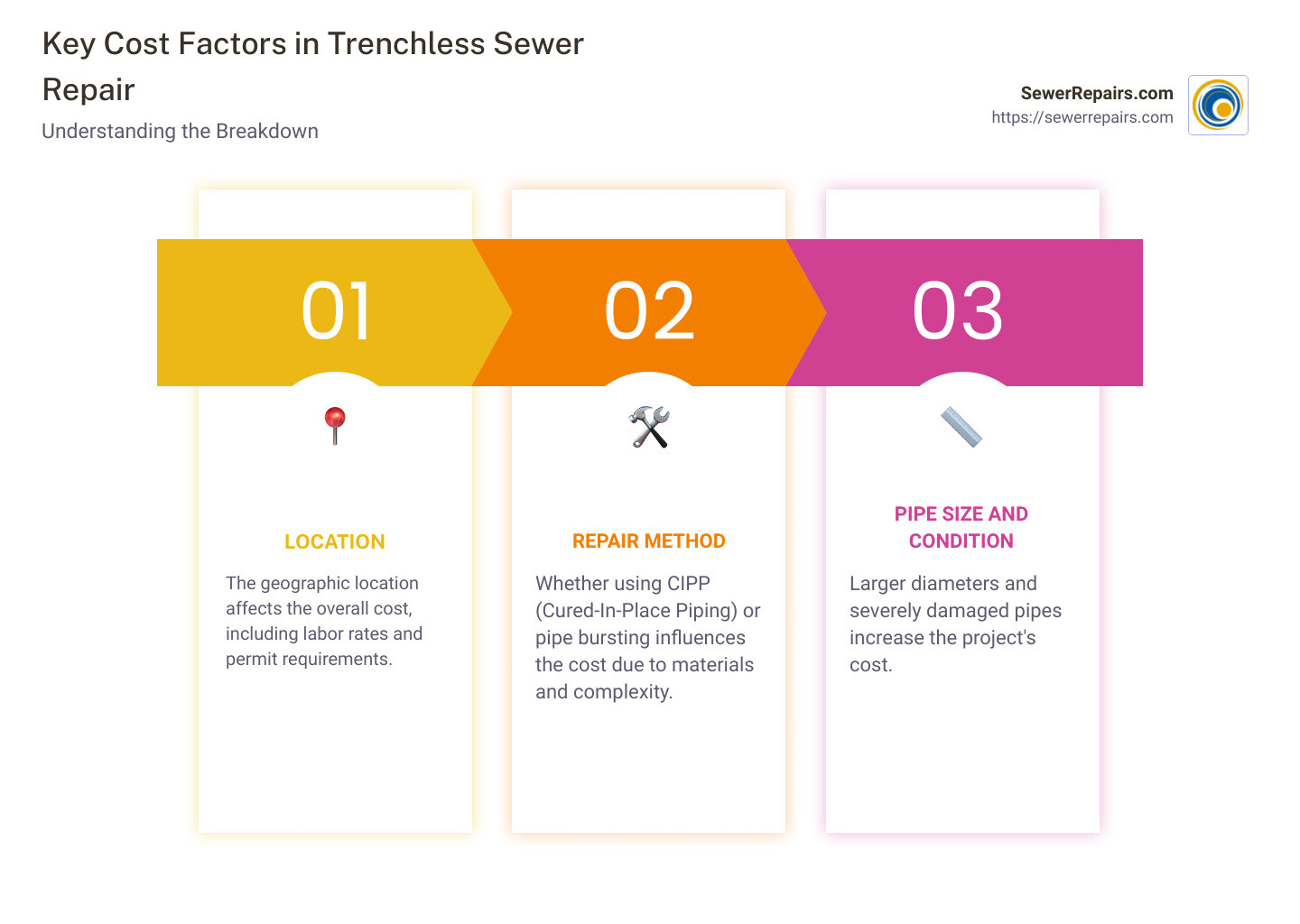
Understanding the cost of trenchless sewer repair requires looking at several key factors. These include the size and length of the pipe needing repair, the specific repair method used (like pipe lining or bursting), any necessary excavation, and the permits required by local laws. Let’s break these down for a clearer picture.
Size and Length
The diameter and length of your sewer pipe play a big role in determining the cost of trenchless sewer repair. On average, sewer lines measure between 50 and 75 feet, but this can vary greatly depending on the property size and the location of the connection to the municipal line. Costs are typically calculated per linear foot, with trenchless repair methods ranging from $135 to $285 per linear foot. This means, for an average length, you’re looking at a significant part of your total cost being tied directly to how many feet of pipe need attention.
Pipe Lining and Bursting
Two common trenchless repair methods are pipe lining and pipe bursting. Pipe lining involves inserting a resin-coated liner into the damaged pipe, which is then inflated and cured to form a new pipe within the old one. Pipe bursting requires breaking and displacing the old pipe while simultaneously pulling a new pipe into place. Each method has its own cost implications. Pipe lining costs between $135 and $150 per linear foot, while pipe bursting can range from $150 to $190 per linear foot. The choice between lining and bursting will depend on the condition of your existing pipes and the specific challenges of your repair job.
Excavation and Permits
Despite being less invasive, trenchless sewer repairs may still require some excavation to create access points for the repair equipment. This excavation is minimal compared to traditional methods, but it can add to the overall cost, especially if obstacles like tree roots or utility lines are present. Costs for excavation labor can range from $60 to $250 per hour.
Permits are another factor that can affect the cost of trenchless sewer repair. Depending on where you live, obtaining the necessary permits to begin work can cost up to $1,000. Local laws vary widely, so it’s important to understand the requirements in your area. This is not an area to cut corners in, as proper permitting ensures the work is done safely and up to code.
In summary, the cost of trenchless sewer repair is influenced by several factors, including the size and length of your sewer line, the repair method chosen, any necessary excavation, and the cost of permits. While trenchless methods can be more cost-effective than traditional repairs, especially when considering the reduced need for property restoration, the total cost can still vary widely based on these factors. It’s important to get a detailed estimate from a reputable provider like SewerRepairs.com to understand the full scope and cost of your project.
Pros and Cons of Trenchless Repair
When it comes to fixing your sewer lines, trenchless repair methods offer a modern alternative to traditional excavation. But like any repair method, it has its ups and downs. Let’s break it down in simple terms so you can make an informed decision.
Advantages
Savings: Generally, trenchless repair is a wallet-friendly option. Since there’s minimal digging involved, you save on the costs that would otherwise go into fixing up your yard or driveway after the job. It’s all about doing the work without turning your property into a construction site.
Efficiency: Trenchless repair methods are quick. In many cases, the work can be completed in a day or so, which is a fraction of the time required for traditional repairs. This means less disruption to your daily life and routine.
Property Preservation: One of the biggest perks of trenchless repair is how it spares your landscape. There’s no need to tear up your garden or remove structures that are in the way. This method keeps your property intact, which is a relief for any homeowner.
Disadvantages
Not Suitable for All Pipes: Trenchless repair isn’t a one-size-fits-all solution. If your sewer pipes are in extremely poor condition or have collapsed, this method might not be feasible. It’s best for fixing leaks, cracks, or minor damage.
Potential for Unforeseen Costs: While trenchless repair is generally cost-effective, there can be unexpected issues that raise the price. For example, if the initial inspection misses some hidden damage or if there are obstacles that complicate the repair, you might end up paying more than you anticipated.
In summary, trenchless sewer repair comes with a host of benefits, including significant savings, quick completion times, and minimal impact on your property. However, it’s not suitable for every situation, and there’s always a chance that unforeseen complications could increase the cost. Before making a decision, it’s wise to consult with experts like those at SewerRepairs.com. They can assess your specific situation and provide a clear understanding of what to expect, ensuring that you choose the best repair method for your needs.
Comparing Costs: Trenchless vs. Traditional
When it comes to fixing your sewer lines, understanding the cost differences between trenchless and traditional repair methods is crucial. Let’s break it down in simple terms so you can see where the savings come in, and why trenchless might be the way to go for you.
Traditional Repair Costs
Digging Up: Traditional methods involve a lot of digging. This means tearing up your yard, driveway, or even street to get to the sewer line. It’s not just about fixing the pipe; it’s about fixing everything above it afterward.
Labor Intensive: More digging means more people and more hours. Labor costs can skyrocket as the complexity and duration of the job increase.
Landscaping Costs: Once the repair is done, you then have to pay to put everything back as it was. Restoring landscaping, driveways, and sidewalks can add thousands to the bill.
Trenchless Savings
Minimal Excavation: Trenchless methods like CIPP (Cured-In-Place Pipe) lining or pipe bursting require little to no digging. This means less disruption and no landscaping costs to worry about after the fact.
Efficiency: Trenchless repairs can often be completed in a day or two, unlike traditional methods that can take a week or more. Less time means less labor cost.
No Landscaping Restoration Needed: Since trenchless repairs cause minimal surface disruption, you save a bundle on not having to restore your property’s exterior.
Labor and Landscaping Costs
Traditional Methods: The combined cost of labor and landscaping restoration means traditional repairs can be expensive. You’re paying for the time, the people, and the materials to fix not just the pipe, but everything else affected by the repair.
Trenchless Methods: The cost is more upfront in terms of the technology and expertise required. However, when you factor in the savings on labor and landscaping, trenchless often comes out on top.
In a nutshell, while trenchless sewer repair might seem pricier at first glance, the overall savings are significant when you consider the reduced labor and virtually nonexistent landscaping costs. Plus, the convenience of having your yard or driveway remain intact is something you can’t put a price on.
Before making a decision, it’s wise to consult with experts like those at SewerRepairs.com. They can provide a detailed analysis of your situation, helping you understand the potential costs and savings, ensuring you make an informed decision. Trenchless repair is not just about fixing a problem; it’s about doing it in the most efficient, least disruptive way possible.
Frequently Asked Questions about Trenchless Sewer Repair
When considering trenchless sewer repair, homeowners often have questions about its value, durability, and application. Let’s dive into some of the most common inquiries.
Is Trenchless Sewer Repair Worth It?
Absolutely. Trenchless sewer repair offers a significant advantage over traditional digging methods. It’s less invasive, meaning your yard, driveway, and landscaping remain largely untouched. This alone can save you thousands in restoration costs. Additionally, the process is quicker, often completed in a day, minimizing disruption to your daily life.
When you weigh these benefits against the cost, trenchless repair often emerges as the more economical choice in the long run, especially when you factor in the absence of repair costs for property damage typical of traditional methods.
How Long Does Trenchless Repair Last?
Trenchless sewer repairs are designed for longevity. Cured-in-place pipe (CIPP), a common trenchless method, can last 50 years or more. This technology involves creating a new, durable pipe within the old one, effectively renewing your sewer system without the need for excavation. The materials used in trenchless repairs are resistant to common issues like root intrusion and corrosion, ensuring a long-term solution for your plumbing woes.
Can All Pipes Be Repaired Trenchlessly?
While trenchless repair is versatile and effective, it’s not a one-size-fits-all solution. The suitability of trenchless repair methods depends on several factors, including the condition, material, and configuration of the existing pipes. Pipes that are severely collapsed may not be candidates for trenchless repair and might require excavation to replace.
However, for many homes, trenchless methods like pipe lining or bursting are viable options that can repair or replace sewer lines without the need for extensive digging. It’s important to have a professional assessment to determine the best approach for your specific situation.
In Conclusion, trenchless sewer repair offers a cost-effective, durable solution for many homeowners facing sewer line issues. While not suitable for every scenario, its benefits of minimal disruption, quick completion time, and long-lasting results make it a worthwhile consideration for those looking to repair or replace their sewer lines efficiently. Consulting with experts like those at SewerRepairs.com can provide clarity and ensure that you’re making the best decision for your home and budget.
Conclusion
Tackling sewer line problems can be daunting, but with advancements in trenchless technology, the process has become less intrusive and more cost-effective. At SewerRepairs.com, we specialize in providing trenchless sewer repair services that not only save your yard from excavation but also save you money in the long run.
Why Choose Trenchless Sewer Repair with SewerRepairs.com?
- Minimal Disruption: Our trenchless repair techniques mean your daily life is hardly disrupted. You won’t have to deal with the mess of a dug-up yard or the inconvenience of a lengthy repair process.
- Cost-Effective Solutions: We understand the importance of cost in your decision-making. Trenchless sewer repair is generally less expensive than traditional methods when you consider the additional costs of landscape restoration and time.
- Expertise You Can Trust: Our team is equipped with the knowledge and technology to assess and address your sewer problems efficiently. We ensure that you’re getting the best solution for your specific situation.
Long-Term Investment
Investing in trenchless sewer repair is a long-term investment in your property. Not only does it address the immediate issue with minimal impact on your property, but it also prevents future problems, thanks to the durability of the materials and techniques we use. The sewer line solutions we provide are designed to last, giving you peace of mind and saving you money on potential future repairs.
Informed Decision-Making
We believe in empowering our customers with information to make informed decisions. Understanding the cost of trenchless sewer repair and its benefits compared to traditional methods is crucial. Our team is here to guide you through the options, explaining the process, and providing transparent cost estimates.
Choosing the right solution for your sewer line issues doesn’t have to be complicated. With SewerRepairs.com, you’re choosing a partner that values your property, time, and investment. We’re dedicated to providing you with a seamless, efficient repair process that gets your system back in working order as quickly as possible.
Contact us today to learn more about how trenchless sewer repair can benefit you and to schedule an assessment. Let’s work together to find the best solution for your sewer line needs.